
What Touches Your Skin Matters: Understanding 100% Organic Cotton in Women’s Hygiene
What Touches Your Skin Matters
When choosing a period pad or nursing pad, most people naturally look at the obvious features first.
How absorbent is it?
Will it stay in place?
Will it protect against leaks?
Is it long enough?
Does it have wings?
Those are important questions.
But there is another question that deserves attention:
What material is actually touching your skin?
A sanitary pad can remain in contact with the external genital area for several hours. A maternity pad may be worn repeatedly during postpartum recovery. A nursing pad sits directly against breast and nipple skin while absorbing leaking breast milk.
For women and mothers across Kenya, from Nairobi and Mombasa to Kisumu, Nakuru and Eldoret, understanding that skin-contact layer can make product labels easier to evaluate.
This is especially important because phrases such as “cotton-soft,” “cotton feel,” “cotton-like” and “100% organic cotton” are not interchangeable.
Moyo Comforts has previously explained that a disposable sanitary pad contains several functional layers and that a claim such as “100% organic cotton coversheet” refers specifically to the layer closest to the body, not automatically every material inside the finished pad.
What Is the Top Sheet or Skin-Contact Layer?
The top sheet, sometimes called the coversheet or skin-contact layer, is the upper surface of a sanitary pad.
It is the part that sits directly against the body and receives menstrual fluid first.
Below that surface, a disposable pad can contain other materials that perform different jobs, such as moving fluid downward, absorbing and storing it, helping prevent leakage and keeping the pad attached to underwear.
This means a modern sanitary pad is usually not made from one single material.
So when a product says:
“100% Organic Cotton Coversheet”
that tells you something specific and useful:
the fibre used in the layer touching the body is organic cotton.
It does not automatically mean that the absorbent core, adhesive, wings and leak-resistant backing are also made exclusively from cotton.
That distinction helps Kenyan consumers compare products more accurately.
What Does 100% Organic Cotton Actually Mean?
Organic cotton is not simply cotton that feels softer.
According to Textile Exchange, organic cotton is cotton grown and certified according to organic agriculture standards. Organic systems rely on ecological processes and avoid toxic and persistent synthetic agricultural chemicals and genetically modified seeds. Independent certification is important to substantiate an organic claim.
There are also standards designed to verify organic content through a supply chain. Textile Exchange explains that its Organic Content Standard uses third-party certification to verify the amount of organically grown material in a final product.
For consumers, the practical takeaway is simple:
“Organic” should refer to a verifiable material claim, not just a green colour, cotton picture or natural-looking package.
Cotton-Like vs Organic Cotton: They Are Not the Same
This is one of the most common misunderstandings in women’s hygiene.
A sanitary pad can have a surface described as:
“cotton-like”
“cottony soft”
“cotton feel”
or
“soft as cotton”
without necessarily containing cotton fibre.
These words often describe texture or feel.
A synthetic nonwoven material can be engineered to feel smooth and soft against the body.
That does not automatically make the material bad or unsafe.
It simply means:
Cotton-like describes how something feels. Organic cotton describes what the fibre actually is and how it was sourced.
For shoppers in Nairobi supermarkets, Mombasa pharmacies or online stores serving Kenya, reading the complete wording on the packaging matters more than simply seeing the word “cotton.”
Why Does Skin-Contact Material Matter in Women’s Hygiene?
The vulvar area can be sensitive to friction and certain irritants.
ACOG identifies perfumes, dyes, fabrics and other substances as potential triggers of contact dermatitis. Its vulvar-care guidance specifically suggests switching to 100% cotton menstrual pads if regular pads are irritating.
This does not mean that every non-cotton pad causes irritation.
Many women use conventional sanitary pads comfortably.
But material choice can become more relevant for someone who repeatedly notices discomfort with a particular product.
A woman may prefer organic cotton because she wants:
a clearly identified cotton skin-contact material, a softer-feeling surface, less of a synthetic or plastic-like sensation, or simply greater transparency about what is touching her body.
Benefit 1: Soft Skin-Contact Comfort
Comfort becomes especially noticeable when a product is worn for many hours across a menstrual cycle.
During a normal day, a woman may walk, sit, commute, work, exercise and sleep while wearing period protection.
Friction, movement, sweat and moisture can make the surface of the product feel more noticeable.
A soft cotton contact layer may appeal to users who dislike certain mesh-like or plastic-feeling surfaces.
For women commuting through Nairobi, working long days in Mombasa, studying in Kisumu or travelling between Nakuru and Eldoret, comfortable skin contact can be an important part of choosing period care.
However, softness alone does not determine whether a pad performs well.
Absorbency, fit and leak protection still matter.
Benefit 2: Greater Material Transparency
One of the strongest reasons to look for precise organic cotton wording is not fear, it is clarity.
Compare these two statements:
Cotton-soft surface
and
100% Organic Cotton Coversheet
The second tells the customer significantly more.
The consumer knows the actual fibre being claimed in the skin-contact layer.
This is particularly valuable as Kenyan shoppers become more interested in the ingredients and materials used in skincare, baby products, period care and maternity products.
Knowing exactly what the claim applies to helps a woman make her own decision.
Benefit 3: An Alternative for Some Sensitive-Skin Users
Some women experience irritation from certain menstrual products.
That can involve several factors, including friction, fragrance, dyes, adhesives, moisture or individual sensitivity.
ACOG advises avoiding deodorant-containing pads and products with potentially irritating plastic coatings when vulvar irritation is a concern.
For someone who finds her usual sanitary pad uncomfortable, trying a pad with a cotton skin-contact layer may be reasonable.
But it is important not to turn that into an exaggerated medical promise.
Organic cotton does not guarantee that every user will avoid irritation.
Persistent itching, burning, unusual discharge, pain or recurring rashes should be evaluated by a qualified healthcare professional.
Benefit 4: Organic Sourcing Matters to Some Consumers
For some women, the attraction of organic cotton extends beyond skin feel.
It is also about how the cotton fibre was produced.
Organic cotton standards address agricultural production and certification, and recognised content standards can help track organic fibre through the supply chain.
That can appeal to consumers who prefer products with more traceable sourcing.
However, brands should be careful not to make environmental claims that go beyond their actual certification.
For example, an organic cotton coversheet does not automatically mean an entire disposable pad is:
plastic-free, compostable, biodegradable or made exclusively from plant-based materials.
Each of those is a separate claim requiring its own evidence.
What Organic Cotton Does NOT Mean
This is especially important for responsible women’s health education.
100% organic cotton does not automatically mean that a product:
-
prevents vaginal infections
-
treats rashes
-
prevents mastitis
-
eliminates every allergy
-
prevents postpartum complications
-
can be worn indefinitely without changing
-
is entirely biodegradable
-
contains no synthetic material anywhere
-
provides better absorbency solely because it is organic
-
guarantees zero leakage
The material touching the skin is one part of the overall product.
A good sanitary pad still requires a reliable absorbent system, suitable length, secure wings and appropriate coverage.
A nursing pad still needs to absorb breast-milk leakage effectively and remain correctly positioned.
What Happens If You Do Not Use Organic Cotton?
There is no medical rule saying women must use organic cotton.
A properly manufactured non-organic or synthetic-containing hygiene product may work safely and comfortably for many users.
So the correct comparison is not:
Organic = safe
Non-organic = dangerous
Instead, ask:
Does this product suit my skin, flow, comfort preference and daily needs?
A conventional product may become uncomfortable for an individual user because of fragrance, surface texture, friction, excessive moisture or another ingredient.
Another woman may use the same product without any problem.
This is why product choice should be individual rather than fear-based.
Why Fragrance Can Matter as Much as Material
When people discuss “natural” period care, they sometimes focus exclusively on cotton and overlook another important factor: fragrance.
ACOG recommends deodorant-free menstrual products as part of vulvovaginal care and notes that perfumed products may irritate sensitive tissue.
So a woman experiencing discomfort should not assume that synthetic fibre is automatically the cause.
The issue could potentially involve fragrance, dye, detergent residue, prolonged moisture, friction or another factor.
That distinction makes women’s hygiene education more useful.
Organic Cotton in Everyday Period Care: Moyo Comforts Maxi Pads
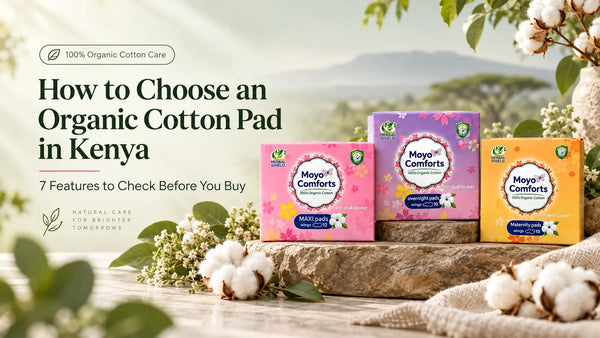
For everyday menstrual protection, Moyo Comforts currently lists Maxi Pads as part of its organic cotton period-care range in Kenya. Its current collection presents Maxi Pads alongside Overnight, Maternity and Nursing Pads.
Maxi Pads are intended for menstrual flow where absorbency, coverage and secure positioning matter.
For Moyo Comforts content, the strongest message is not simply “organic is better.”
A more accurate product story is:
organic cotton skin-contact comfort combined with absorbency and protection designed for period use.
This allows women in Nairobi, Kisumu, Thika or elsewhere in Kenya to consider both material and performance, rather than sacrificing one for the other.
Organic Cotton for Night-Time Period Care: Moyo Comforts Overnight Pads
Night-time protection has different demands.
While sleeping, body position changes and menstrual fluid may move differently than it does while standing or walking.
That makes length, back coverage and secure wings important.
Moyo Comforts currently sells Overnight Pads in Kenya and positions the product around extended night protection, wings and its LeakLocker™ system, alongside organic cotton positioning.
For a woman in Nairobi, Mombasa, Nakuru or Eldoret, the decision therefore should not be:
organic cotton OR strong protection.
The goal should be both:
comfortable skin contact + protection suited to night-time flow.
One caution for website copy: current product pages contain several performance claims. Any claim involving specific protection hours, antimicrobial action, dermatology testing or certification should continue to match the latest validated product documentation before publishing it in advertising.
Organic Cotton in Postpartum Care: Moyo Comforts Maternity Pads
Postpartum bleeding, known as lochia, creates another situation where material remains in close contact with sensitive skin.
Maternity pads are designed for postpartum use rather than simply being regular menstrual pads with different packaging.
Moyo Comforts' current hospital-bag education describes its Maternity Pads as using a 100% organic cotton coversheet, together with coverage and wings for postpartum use.
For new mothers preparing for birth in Nairobi, Mombasa, Kisumu, Nakuru, Eldoret or elsewhere in Kenya, a cotton skin-contact layer may be appealing as a comfort preference during postpartum recovery.
But maternity pads manage normal postpartum bleeding, they do not treat postpartum complications.
Sudden or unusually heavy bleeding after childbirth requires medical assessment regardless of which pad is being used.
Organic Cotton Beyond Periods: Moyo Comforts Nursing Pads
Women’s organic care does not end with menstruation.
Breastfeeding mothers may experience breast-milk leakage between feeds, during let-down, at work, while travelling or overnight.
Nursing pads sit directly against breast and nipple skin while absorbing that milk.
Moyo Comforts currently markets 100% Organic Cotton Disposable Nursing Pads, with 30 pads per pack, as part of its Mom Care range.
This is where the concept “what touches your skin matters” applies particularly well.
A nursing pad should offer:
soft contact, effective absorption, comfortable fit and appropriate moisture management.
A wet nursing pad should still be replaced promptly.
Organic cotton does not mean the same nursing pad should be worn all day once saturated.
Organic Cotton Care for Kenyan Women at Different Life Stages
One reason this topic works well for Moyo Comforts is that organic cotton can be discussed across different stages of women's lives.
A university student in Kisumu may need dependable everyday menstrual protection.
A working woman in Nairobi may want Maxi Pads for daytime use and Overnight Pads at night.
A new mother in Nakuru may need Maternity Pads after childbirth.
A breastfeeding mother in Mombasa may use Nursing Pads for breast-milk leakage.
Women in Eldoret, Thika, Machakos, Nyeri, Naivasha, Kakamega, Kitale and Meru may have the same basic question:
What exactly is touching my skin, and does this product suit my needs?
That is the broader role of organic cotton education.
It gives consumers more information with which to make that choice.
How to Read an Organic Cotton Product Claim in Kenya
When shopping for period or maternal-care products, do not judge the packet solely by green colours, leaves or pictures of cotton.
Read the wording carefully.
Look for whether the claim refers to:
the entire finished product, the coversheet/top sheet, or another specific component.
Then consider the rest of the product.
For period pads, assess absorbency, wings, length and flow suitability.
For overnight protection, check extended coverage.
For maternity pads, check postpartum suitability and coverage.
For nursing pads, consider absorbency, softness and fit.
Organic cotton is one feature, not the only feature.
Choosing Period Care for Kenya’s Climate and Daily Routines
Local lifestyle can also affect comfort.
A hot, humid day in Mombasa may feel very different from a cooler morning in Nairobi, Nyeri or Nakuru.
A woman sitting in Nairobi traffic may wear her period product for long periods between changes.
A healthcare worker in Eldoret may spend much of her shift moving.
A student in Kisumu may need protection through lectures and commuting.
Whatever the city, correct pad changing still matters.
No organic material turns a disposable hygiene product into an unlimited-wear product.
Replace menstrual products according to flow, wetness, comfort and product instructions.
Can Organic Cotton Prevent Period Rashes?
No product can guarantee that.
A rash or irritation can result from many causes, including moisture, friction, fragrance, detergent, individual sensitivity and skin conditions.
ACOG's recommendation to consider cotton menstrual pads when regular pads are irritating supports cotton as an option for some sensitive users—but it is not a promise that cotton cures a rash.
If symptoms continue, professional assessment is more appropriate than repeatedly changing brands without understanding the cause.
Does Organic Cotton Prevent Vaginal Infections?
No.
Organic cotton period products should not be marketed as products that prevent or treat vaginal infections.
Vaginal infections can arise for different reasons and require the right diagnosis.
A period pad manages menstrual flow.
Its job is not to treat disease.
If you experience persistent unusual discharge, strong odour, significant itching, burning, pelvic pain or another concerning symptom, contact a qualified healthcare provider.
Frequently Asked Questions
What is the top sheet of a sanitary pad?
The top sheet or coversheet is the upper layer that sits closest to the body and receives menstrual fluid before it moves into the absorbent layers below.
Is cotton-like the same as cotton?
No. “Cotton-like” typically describes texture or softness. It does not by itself prove that the material contains cotton.
What does 100% organic cotton coversheet mean?
It means the cotton fibre used in that specific skin-contact layer is claimed as 100% organic cotton. It does not automatically describe every material inside the whole disposable pad.
Is organic cotton better for sensitive skin?
Some women who find regular pads irritating may prefer cotton. ACOG includes switching to 100% cotton menstrual pads among measures that may minimise vulvar irritation.
Are non-organic pads harmful?
Not automatically. Many women use properly manufactured conventional pads without problems. Individual material preference and sensitivity vary.
Does organic cotton stop infections?
No. Organic cotton is a material choice, not an infection-prevention treatment.
Does Moyo Comforts offer organic cotton pads in Kenya?
Yes. Moyo Comforts' current online range includes Maxi Pads, Overnight Pads and Maternity Pads within its organic cotton period-care offering.
Does Moyo Comforts have organic cotton nursing pads?
Yes. Its current range includes Organic Disposable Nursing Pads, with 30 pads per pack.
Can I buy Moyo Comforts organic cotton products in Nairobi?
Moyo Comforts operates a Kenya ecommerce website and currently lists its period, maternity and nursing products online.
Final Thoughts: What Touches Your Skin Matters
Women’s hygiene is about more than absorption.
It is also about comfort, fit, material transparency and understanding what a product is designed to do.
A clearly identified 100% organic cotton coversheet or skin-contact layer gives women more information about the material sitting directly against their body.
For some women, that cotton surface may feel softer or more comfortable.
For others, the biggest benefit may simply be knowing exactly what material they are choosing.
But organic cotton should never be turned into fear-based marketing.
Non-organic does not automatically mean unsafe.
Organic cotton does not prevent every rash or infection.
Organic cotton does not replace absorbency, fit or correct changing habits.
And organic cotton does not mean every layer of a disposable hygiene product is made entirely from cotton unless the product documentation specifically confirms that.
For women and mothers across Kenya, from Nairobi and Mombasa to Kisumu, Nakuru, Eldoret and beyond, Moyo Comforts provides organic cotton options for different moments of care, including Maxi Pads, Overnight Pads, Maternity Pads and Nursing Pads.
The most useful question is therefore not simply:
“Is it organic?”
It is:
What touches my skin, what does the product actually contain, and does it provide the comfort and protection I need?
That is what informed women’s hygiene should look like.