
Why More Women in Kenya Are Choosing 100% Organic Cotton Period Care
Period Care in Kenya Is Becoming More Material-Conscious
For years, choosing sanitary pads often came down to a few basic questions:
Will it absorb enough?
Will it leak?
How much does it cost?
Does it have wings?
Those questions still matter.
But today, many women in Kenya are also paying closer attention to the material closest to their bodies.
A shopper in Nairobi, Mombasa, Kisumu, Nakuru or Eldoret may now see terms such as:
cotton soft
cotton feel
natural
organic cotton
100% organic cotton
printed on period-care packaging.
The problem is that these terms do not always mean the same thing.
A pad can feel cotton-like without actually using cotton in its skin-contact surface. And even when organic cotton is used, the claim may apply to one particular layer rather than the entire finished sanitary pad.
That is why understanding the difference matters.
Moyo Comforts has already addressed this distinction in its existing guide to organic cotton versus cotton-like sanitary pads. Its current educational content explains that disposable pads contain multiple functional layers and that “100% organic cotton coversheet” is different from saying the entire pad is made only from cotton.
What Is Organic Cotton?
Organic cotton is still cotton, but it is grown and certified according to recognised organic agriculture standards.
According to Textile Exchange, organic cotton production relies on ecological processes and avoids toxic and persistent synthetic agricultural chemicals and genetically modified seeds. Credible organic cotton claims also depend on certification and traceability through the supply chain.
This means the word “organic” is not simply a description of softness.
It relates primarily to how the cotton fibre was grown and verified.
That is different from a phrase such as cotton-like, which normally describes how a material feels rather than proving that cotton is actually present.
Organic Cotton vs Cotton-Like: What Kenyan Shoppers Should Know
Imagine two period pads sold in a Nairobi pharmacy.
One says:
Cotton-Like Soft Surface
The other says:
100% Organic Cotton Coversheet
Those statements are not interchangeable.
“Cotton-like” may describe a synthetic nonwoven material engineered to feel soft.
“100% organic cotton coversheet” identifies the fibre used in the surface layer that touches the body.
Neither phrase alone tells you whether the pad will absorb enough or prevent leaks.
That depends on the complete product construction.
But if knowing the skin-contact material matters to you, the second statement provides more specific information.
Why Does the Material Touching Your Skin Matter?
A sanitary pad remains close to the external genital skin for hours at a time.
During a period, the area may also experience:
menstrual moisture, sweat, friction, heat, movement and repeated pad changes.
That does not mean normal sanitary pads automatically damage the skin.
Most women can use properly designed menstrual products without developing a medical problem.
However, some people have particularly sensitive vulvar skin or may react to certain fragrances, dyes, adhesives or other materials.
ACOG identifies soaps, perfumes and fabrics as possible triggers for contact dermatitis, and its vulvar-care advice recommends avoiding irritating products. It also specifically advises people with irritation to consider cotton menstrual pads if regular pads are causing problems.
For some Kenyan women, therefore, choosing a clearly identified cotton skin-contact surface is mainly about comfort and material preference.
Benefits of Choosing 100% Organic Cotton Period Care
1. A Soft Cotton Skin-Contact Surface
One of the biggest reasons women choose cotton-based period care is simply how the material feels against the skin.
Cotton is a natural fibre and may provide a softer-feeling contact surface for users who dislike slick, plastic-like or mesh-style topsheets.
This can be particularly relevant during the first heavier days of a period, when a woman may be wearing and replacing sanitary pads throughout the entire day.
For women commuting around Nairobi, working long shifts in Mombasa, attending university in Kisumu or travelling between Nakuru and Eldoret, comfort matters because period protection is being worn while walking, sitting, travelling and sleeping.
Organic cotton is not medicine.
But choosing a surface you personally find comfortable can make everyday period management easier.
2. Greater Material Transparency
The phrase 100% organic cotton coversheet tells the customer exactly what fibre is used in that specific layer.
That is valuable because “soft,” “cottony” and “natural-feel” marketing terms do not necessarily identify actual fibre composition.
More women in Kenya are becoming interested in ingredient and material transparency across skincare, baby care and personal hygiene.
Period products are becoming part of the same conversation.
Rather than asking only:
“Is this pad soft?”
consumers can ask:
“What is the surface actually made from?”
That is a more informed way to shop.
3. An Option for Women Who Find Some Regular Pads Irritating
Some women report irritation from certain menstrual products.
This does not mean all non-organic pads cause rashes.
In fact, published safety assessments have found properly manufactured synthetic-containing menstrual products can be well tolerated.
But individual sensitivities differ.
There are documented cases of allergic contact dermatitis linked to specific sanitary-pad ingredients, including certain adhesives or additives. These are individual reactions rather than proof that all conventional pads are harmful.
If a particular pad repeatedly causes itching, burning, redness or discomfort, changing products may help and persistent symptoms should be assessed by a healthcare professional.
For some women, a cotton-contact pad may be worth trying.
4. Less Dependence on a Plastic-Like Skin Feel
Some disposable sanitary pads use polypropylene, polyethylene or other synthetic nonwoven materials in their surface or backing layers.
These materials have useful functions and are not automatically unsafe.
However, some women simply dislike the sensation of a synthetic or plastic-coated surface.
ACOG's general vulvovaginal-care guidance advises avoiding deodorant-containing pads and pads with plastic coating when trying to minimise irritation.
A cotton coversheet can therefore appeal to women looking for a different skin-contact experience.
5. Organic Farming and Traceability
The benefits of organic cotton extend beyond the immediate wearing experience.
Textile Exchange states that conventional cotton production can involve chemically intensive farming, including pesticides and synthetic fertilisers that may affect soil and water, while organic systems restrict toxic and persistent synthetic agrichemicals.
For environmentally conscious women in Kenya, this may make certified organic cotton more appealing.
This is especially relevant among consumers in cities such as Nairobi, Mombasa and Kisumu who increasingly compare not only product performance but also sourcing and sustainability claims.
Again, the exact sustainability claim used by a brand should match its certification evidence.
“Organic” should never be treated as a vague green marketing word.
What Happens If You Do Not Use Organic Cotton Pads?
This is where period-care information needs to stay accurate.
Not using organic cotton does not automatically mean you will experience:
infection, infertility, hormonal problems, cancer, serious vaginal disease or reproductive-health damage.
There is not good evidence to say that every conventional sanitary pad causes these outcomes.
A high-quality non-organic sanitary pad may be perfectly suitable for many women.
The better question is:
What potential disadvantages might some women notice with certain materials or product designs?
And there are several.
Some Synthetic or Plastic-Like Surfaces May Feel Less Comfortable
A woman who prefers cotton may find certain synthetic surfaces hotter, rougher or less comfortable.
The experience is individual.
University of Iowa vulvar-care guidance advises people experiencing vulvar irritation to use pads with a cotton liner and notes that some nylon-style materials may retain moisture.
This does not mean synthetic fibres are dangerous.
It means material choice can affect comfort for some users.
Fragranced or Deodorised Products May Irritate Sensitive Skin
Another common mistake is to confuse “non-organic” with the real issue.
Sometimes the problem is not cotton versus non-cotton at all.
It may be:
fragrance, deodorant, dyes, adhesive, friction or prolonged moisture.
ACOG recommends deodorant-free menstrual pads for vulvar health and advises avoiding perfumes and other potential irritants.
If a scented pad repeatedly causes discomfort, changing to an unscented option may matter more than simply looking for the word “organic.”
Moisture and Friction Can Increase Discomfort
Even the best organic cotton pad can become uncomfortable if worn too long.
UNICEF's menstrual-hygiene product guidance states that disposable pads should be changed and disposed of within roughly four to six hours of use; heavier flow may require earlier changes.
This means:
Organic cotton does not replace good menstrual hygiene.
Whether you are wearing a pad in Thika, Machakos, Nyeri, Naivasha, Kakamega, Kitale or Meru, change it according to your flow and comfort.
Do not leave a saturated pad on simply because its surface is organic cotton.
Organic Cotton Does Not Automatically Mean Better Leak Protection
This is another important myth.
Organic cotton relates mainly to the material.
Leak protection depends on many other factors, including:
pad length, absorbent core, wings, fit, back coverage, fluid distribution and how securely the pad stays in place.
A soft organic cotton surface is not useful if the rest of the pad cannot manage your flow.
That is why the ideal product combines:
comfortable skin-contact material + effective absorbency + secure fit + appropriate coverage.
Moyo Comforts Organic Cotton Period Care in Kenya
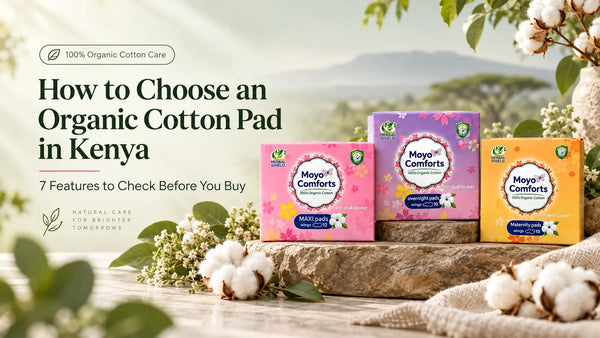
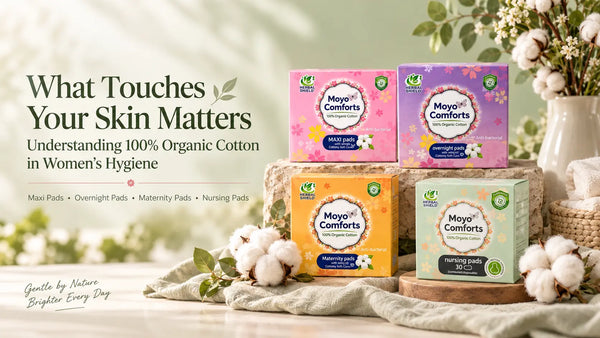
Moyo Comforts' current Kenya range includes dedicated organic cotton options for different period and maternal-care needs. Its current website lists Maxi Pads, Overnight Pads and Maternity Pads as part of its organic cotton period-care range.
For the most precise customer education, it is best to communicate the specific layer correctly.
Moyo's own current educational content identifies its Maxi Pads as using a 100% certified organic cotton coversheet and explains that the organic-cotton surface is combined with the rest of the pad's absorbency and protection system.
Moyo Comforts Maxi Pads for Everyday Period Care in Kenya
Moyo Comforts Maxi Pads are designed for everyday period protection, including medium-to-heavier flow needs.
For women in Nairobi, Kisumu, Nakuru and other parts of Kenya, Maxi Pads can be useful when everyday protection requires more absorbency and coverage than a lighter pad.
Their 100% certified organic cotton coversheet provides the cotton-based skin-contact element, while the wider pad construction handles absorption and fit.
This is an important example of how organic cotton and performance should work together rather than being treated as competing benefits.
Moyo Comforts Overnight Pads for Night Protection
Night-time period care creates a different challenge.
When you sleep, menstrual fluid may travel toward the back or side of the pad depending on your position.
That is why an overnight product needs more than softness.
Moyo Comforts Overnight Pads are positioned around extended night protection and feature the brand's LeakLocker™ system alongside organic cotton positioning.
For women in Nairobi, Mombasa, Eldoret or elsewhere in Kenya who regularly experience night leaks, choosing a product designed specifically for sleep may make more sense than simply using an everyday pad overnight.
Moyo Comforts Maternity Pads for Postpartum Care
Postpartum bleeding is not the same as a normal menstrual period.
Maternity Pads are designed for the greater coverage and absorbency needs associated with bleeding after childbirth.
Moyo Comforts' existing maternal-care content describes its Maternity Pads as using a 100% organic cotton coversheet.
For new mothers preparing for delivery in Nairobi, Mombasa, Kisumu, Nakuru or Eldoret, this gives them an organic cotton skin-contact option while managing normal postpartum bleeding.
However, maternity pads cannot treat excessive postpartum bleeding.
Sudden or very heavy bleeding after childbirth requires medical assessment.
What Should Kenyan Women Look for When Buying Organic Cotton Pads?
Do not choose a pad based on the word organic alone.
Look at the complete product.
Is the organic claim specific?
Does it say organic cotton coversheet or simply “natural”?
Is the fibre certification documented?
Does the pad match my flow?
Does it have sufficient length?
Does it have wings?
Do I need extra back coverage?
Does it feel comfortable?
Is it fragrance-free if I am sensitive to fragrance?
Can I change it easily during my workday or commute?
Does it remain securely positioned?
A woman working in Nairobi may have different needs from someone spending a long day travelling between counties.
A university student in Kisumu may prioritise discreet daytime protection.
Someone experiencing heavier night flow in Nakuru may prioritise extended coverage.
There is no single “best pad” for every woman.
Period Care for Kenya's Different Climates and Lifestyles
Kenyan women live very different routines.
A hot, humid day in Mombasa does not feel the same as a cooler evening in Nairobi or Nyeri.
A woman commuting through Nairobi traffic may sit for long periods.
A healthcare worker in Eldoret may spend hours on her feet.
A student in Kisumu may move between classes all day.
A mother in Nakuru may balance work, travel and childcare.
These real-life differences matter when choosing period care.
Comfort, material, fit, absorbency and regular changing all work together.
Organic cotton may support the material-comfort side of that equation, but it should be combined with the right protection for your actual lifestyle.
Does Organic Cotton Prevent Period Rashes?
No product can guarantee that you will never experience a rash.
Rashes or irritation may result from several factors, including:
friction, sweat, prolonged moisture, perfumes, detergents, skin conditions, pad materials or individual allergies.
A cotton surface may be more comfortable for some women, and ACOG specifically suggests cotton menstrual pads when regular pads are irritating.
But if irritation continues even after switching products, seek medical advice rather than assuming the problem is only your pad.
Does Organic Cotton Prevent Vaginal Infections?
No.
A sanitary pad, organic or otherwise, should not be marketed as preventing or treating vaginal infections.
Vaginal infections can have many different causes.
Changing pads regularly, practising appropriate external hygiene and avoiding irritating products can support menstrual comfort, but these practices do not guarantee infection prevention.
If you experience unusual discharge, strong persistent odour, severe itching, burning, pelvic pain or other concerning symptoms, consult a healthcare professional.
Organic Cotton and Heavy Flow
Women with heavy periods should not choose a product based solely on cotton content.
WHO notes that heavy menstrual bleeding can contribute to iron-deficiency anaemia.
If your period is so heavy that you are repeatedly soaking products very quickly, passing unusually large clots, feeling dizzy, weak or short of breath, or if heavy bleeding disrupts daily life, speak with a healthcare professional.
The right pad can help manage bleeding.
It cannot diagnose or treat the reason for heavy bleeding.
Why Organic Cotton Period Care Is Growing in Kenya
The rise of organic period care is part of a broader shift in consumer behaviour.
Women increasingly want to understand:
what is touching their skin, what materials are used, whether marketing claims are genuine, how products are sourced and whether comfort can be combined with reliable performance.
That shift is visible from Nairobi and Mombasa to Kisumu, Nakuru, Eldoret, Thika, Machakos, Nyeri, Naivasha, Kakamega, Kitale and Meru.
Organic cotton gives shoppers another option.
Not because every other product is automatically harmful.
But because women deserve the ability to choose based on accurate information.
Frequently Asked Questions About Organic Cotton Period Care in Kenya
Are 100% organic cotton pads better than regular pads?
They may be preferable for women who value a cotton skin-contact surface and organic sourcing. However, overall pad quality also depends on absorbency, fit, coverage and construction.
Can normal pads cause infections?
A conventional pad does not automatically cause infection. Some individuals may experience irritation from specific materials, fragrance, dyes or prolonged wetness, but infections have many possible causes.
Are organic cotton pads good for sensitive skin?
Some people with sensitive vulvar skin may find cotton products more comfortable. ACOG recommends considering cotton menstrual pads when regular pads are irritating.
Do organic cotton pads need to be changed less often?
No. Organic cotton does not mean unlimited wear time. Pads should still be replaced according to flow, wetness and hygiene needs.
Are Moyo Comforts Maxi Pads organic cotton?
Moyo Comforts' current educational material describes its Maxi Pads as having a 100% certified organic cotton coversheet.
Does Moyo Comforts have organic cotton Overnight Pads?
Yes. Moyo Comforts currently lists its Overnight Pads within its organic cotton period-care range.
Are Moyo Comforts Maternity Pads organic cotton?
Moyo Comforts currently describes its Maternity Pads as using a 100% organic cotton coversheet.
Where can I find organic cotton period care in Nairobi and Kenya?
Moyo Comforts sells period and maternal-care products through its Kenya website, with its current online collection including Maxi, Overnight, Maternity and Nursing Pad options.
Final Thoughts
Women in Kenya are becoming more thoughtful about period care.
Absorbency still matters.
Leak protection still matters.
Price still matters.
But what touches the skin matters too.
A 100% organic cotton coversheet provides a clearly identified natural-fibre option for women who prefer cotton against their skin and want greater transparency around the materials in their period products.
For some women, this can mean a softer-feeling and more comfortable period-care experience.
At the same time, the message should remain responsible:
Non-organic pads are not automatically dangerous.
Organic cotton does not cure infections.
Organic cotton does not guarantee that a rash will never happen.
And organic cotton alone does not determine whether a pad will protect against leaks.
The best period care combines the right material with appropriate absorbency, fit, coverage, hygiene and changing habits.
For women across Nairobi, Mombasa, Kisumu, Nakuru, Eldoret and throughout Kenya, Moyo Comforts offers organic-cotton period-care options designed around different moments—from everyday Maxi protection and Overnight coverage to Maternity Pads for postpartum care.
The goal is not to make women afraid of every material that is not organic cotton.
The goal is to give Kenyan women more information, more choice and better understanding of what they use against their bodies every month.