
How to Choose an Organic Cotton Pad in Kenya: 7 Features to Check Before You Buy
Choosing an Organic Cotton Pad in Kenya Is About More Than the Word “Organic”
Walk into a supermarket, pharmacy or personal-care store in Kenya and the sanitary-pad aisle can quickly become confusing.
One pack says:
Cotton soft.
Another says:
Cotton feel.
Another says:
100% organic cotton.
And another may say:
100% organic cotton coversheet.
These phrases may look similar, but they do not necessarily describe the same thing.
A pad can feel soft without actually being made from cotton. And even when organic cotton is used, the organic claim may refer specifically to the top sheet or coversheet that touches the body rather than every material inside the finished sanitary pad. Moyo Comforts has already addressed this distinction in its current Kenya educational content.
So if you are looking for organic cotton sanitary pads in Kenya, do not choose based on the front of the packet alone.
Look at the complete product.
Here are the seven features worth checking.
1. Check Exactly What the 100% Organic Cotton Claim Refers To
This should be your first step.
Organic cotton is cotton grown and certified according to recognised organic agricultural standards. Textile Exchange notes that third-party certification is important for verifying organic cotton claims and that supply-chain standards such as OCS and GOTS can help track organic fibre through production.
But on a disposable sanitary pad, the phrase 100% organic cotton needs context.
For example:
100% Organic Cotton Coversheet
is different from:
Entire pad made from 100% organic cotton.
A disposable sanitary pad normally contains multiple functional components. The top layer handles skin contact and fluid transfer, while other layers contribute to absorption, fluid retention, leakage control and attachment to underwear.
So when shopping in Nairobi, Mombasa, Kisumu or online anywhere in Kenya, look for precise wording.
Ask:
Does the pack say which layer is organic cotton?
If the claim applies specifically to the coversheet, that is still useful information—it means the skin-contact layer is being clearly identified.
Cotton-like is not the same as organic cotton
A phrase such as “cotton-like soft surface” generally describes feel.
It does not, by itself, prove the material is cotton.
That does not mean cotton-like pads are automatically bad or unsafe. It simply means consumers should not interpret texture-based marketing as a fibre-composition claim.
What to check before buying:
Look for specific wording such as organic cotton coversheet, a clear percentage, and where certification is claimed, supporting certification information.
2. Check Whether the Skin-Contact Surface Feels Comfortable for You
Material matters because the top surface of a sanitary pad sits close to the vulvar area for hours at a time.
During your period, the area may experience:
-
moisture
-
sweat
-
heat
-
friction
-
movement
-
repeated pad changes
This does not mean non-organic pads automatically cause skin problems.
Many women comfortably use conventional menstrual products.
However, some people are more sensitive to certain fragrances, dyes, materials or coatings.
ACOG advises avoiding potential vulvar irritants such as perfumes and dyes and includes switching to 100% cotton menstrual pads when regular pads are irritating.
For some women in Kenya, therefore, an organic cotton skin-contact layer may be attractive because they prefer the feel of cotton against their body.
This may be especially important during long days at work, university or while travelling.
A woman commuting through Nairobi traffic may sit for long periods.
Someone working in Mombasa's warmer climate may be more conscious of heat and moisture.
A student in Kisumu may want something comfortable throughout lectures.
A healthcare worker in Eldoret may spend hours moving around.
Comfort is personal.
The important question is not simply:
“Is organic cotton better?”
It is:
“Does this material feel comfortable against my skin?”
Also check for fragrance
Fragrance is worth considering separately from organic cotton.
ACOG recommends deodorant-free menstrual products for people trying to minimise vulvar irritation.
So if you have previously experienced discomfort with a pad, do not assume that cotton versus synthetic material is the only possible factor.
Fragrance, dye, friction, prolonged moisture or another ingredient may also matter.
3. Match the Pad’s Absorbency to Your Actual Flow
One of the biggest mistakes when buying organic cotton pads is assuming that organic cotton automatically means better absorbency.
It does not.
Organic cotton mainly tells you something about the cotton material and its sourcing.
A pad's absorption performance depends on its whole construction, including the absorbent core and other functional layers. Moyo Comforts' existing educational material makes the same distinction: skin-contact material and overall protection should be evaluated separately.
Before buying, think about your period.
Is your flow:
light?
moderate?
heavy?
Does it become heavier during the first days?
Do you mostly need daytime protection?
Or are night leaks your bigger concern?
A woman with a heavier period in Nairobi may need a different product from someone whose flow is consistently light.
For everyday or heavier daytime flow
A Maxi-style pad may offer the coverage and absorbency you prefer.
Moyo Comforts currently lists Maxi Pads as part of its organic cotton period-care range in Kenya.
For night-time flow
Absorbency alone may not be enough.
At night, you also need to think about where menstrual fluid may move while you change sleeping position.
That brings us to the next feature.
4. Check the Length and Back Coverage
Do not judge a sanitary pad only by how thick it looks.
Length and coverage matter too.
A pad may be highly absorbent but still allow leaks if menstrual fluid reaches an area the pad does not cover.
This is particularly important during:
-
sleep
-
heavier-flow days
-
long journeys
-
extended periods sitting down
-
days when you move a lot
Day pad vs Overnight pad
Your ideal daytime pad does not automatically become your ideal night pad.
During sleep, you may move from your side to your back or stomach.
A longer pad with additional rear coverage can therefore be more practical at night.
Moyo Comforts' current Overnight Pads page highlights features including a wider back panel, secure wings and LeakLocker™ positioning for longer-wear night protection.
If you regularly wake up with leaks at the back of your underwear or bedding, simply choosing a thicker regular pad may not solve the problem.
You may need:
more length + better rear coverage + a secure fit.
For women shopping for overnight pads in Nairobi, Nakuru, Mombasa or elsewhere in Kenya, look at the pad's actual shape rather than relying only on words such as “super absorbent.”
5. Check the Wings and Overall Fit
A sanitary pad cannot absorb menstrual flow effectively if it constantly shifts away from where you need it.
That is why wings and fit matter.
Good wings can help keep the pad positioned around the underwear as you:
walk, sit, stand, sleep, exercise or travel.
But wings are only one part of fit.
Also consider:
-
pad width
-
underwear fit
-
flexibility
-
whether the pad bunches
-
whether the front or back shifts
-
whether the pad remains comfortable when moving
For example, a woman travelling between Nairobi and Nakuru may sit for hours.
Another person working an active shift in Eldoret may be on her feet much of the day.
The same pad may feel different in those situations.
Moyo Comforts currently positions its Overnight Pads around secure wings and extended coverage alongside its organic cotton offering.
Do not buy a pad based on organic cotton alone
Imagine two pads.
Pad A has an organic cotton surface but shifts constantly.
Pad B also has an organic cotton skin-contact layer but fits securely, has appropriate wings and gives you the length your flow needs.
The second option is much more likely to meet your complete period-care needs.
A good period product has to balance material + fit + protection.
6. Choose the Right Pad for the Right Time: Maxi, Overnight or Maternity
One pad should not be expected to do every job.
A useful way to choose period protection in Kenya is to first ask:
“What situation am I buying this for?”
Maxi Pads
Maxi Pads are designed for menstrual use and can be useful when you want more substantial everyday protection.
Moyo Comforts currently lists 100% Organic Cotton Maxi Pads within its Kenya period-care range.
They may be suited to:
-
everyday menstrual flow
-
heavier daytime flow
-
workdays
-
university
-
commuting
-
days when you want additional absorbency
Overnight Pads
Night-time protection has different requirements.
Look for:
-
extended length
-
wider rear coverage
-
wings
-
suitable absorbency
-
secure positioning
Moyo Comforts Overnight Pads are currently part of the brand's organic cotton pad range and are positioned specifically for night-time protection.
Maternity Pads
Maternity Pads have a completely different primary use.
They are designed for postpartum bleeding after childbirth, rather than simply being another regular period pad.
Moyo Comforts currently lists Maternity Pads within its organic cotton maternal-care range, and the brand's own current hospital-bag education describes its Maternity Pads as using a 100% organic cotton coversheet.
So do not think:
largest pad = best pad.
Think:
right pad = product designed for my current need.
For menstrual periods, that may mean Maxi during the day and Overnight at night.
For postpartum care, it may mean a dedicated Maternity Pad.
7. Check the Brand’s Claims, Instructions and Product Transparency
The final feature is not physical.
It is information quality.
Before buying an organic cotton sanitary pad, look at how clearly the brand explains its claims.
Good questions to ask include:
-
Does it clearly identify what is organic cotton?
-
Does it state whether the claim applies to the coversheet?
-
Is the percentage clear?
-
Is certification mentioned?
-
Is the intended use explained?
-
Does it distinguish daytime, overnight and maternity products?
-
Are the wings and coverage shown?
-
Are instructions provided?
-
Is the pack count clear?
-
Does the manufacturer or seller provide contact information?
-
Are major performance claims explained?
Organic cotton certification exists precisely because claims about organically grown fibre should be verifiable rather than based only on packaging aesthetics. Textile Exchange's Organic Content Standard uses third-party certification and chain-of-custody systems to verify organic material content.
Do not let green packaging make the decision for you
Cotton flowers, leaves, beige colours and words such as:
“pure”
“natural”
“eco”
“gentle”
may look reassuring.
But visual design is not proof of fibre composition.
Read the actual claim.
Specific information is more useful than vague natural-looking marketing.
How Moyo Comforts Organic Cotton Pads Fit Different Needs in Kenya
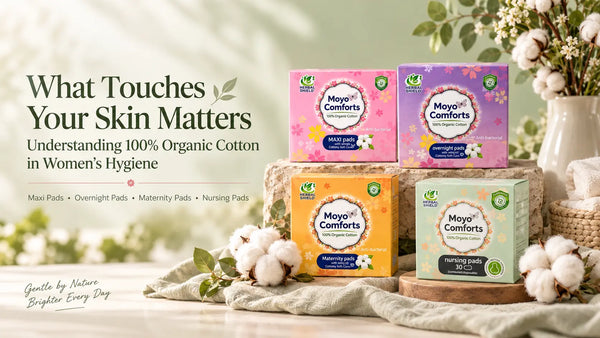
Moyo Comforts currently lists Maxi Pads, Overnight Pads and Maternity Pads in its Kenya pad range, alongside organic cotton nursing care.
The important thing is to choose each product according to its purpose.
Moyo Comforts Maxi Pads
For everyday menstrual care, Maxi Pads can be considered when you want suitable absorbency, coverage and a cotton-contact option.
Moyo's existing educational material describes its Maxi range as using a 100% certified organic cotton coversheet, combined with the broader protection system rather than claiming the coversheet alone provides all absorption.
Moyo Comforts Overnight Pads
For sleep, Moyo Comforts Overnight Pads focus on features such as extended coverage, a wider back area, wings and LeakLocker™ protection alongside organic cotton positioning.
The practical point is simple:
Choose Overnight Pads because they are designed for night protection, not just because they are organic cotton.
Moyo Comforts Maternity Pads
For postpartum bleeding, Maternity Pads provide a dedicated care option.
Moyo's current educational material describes the Maternity Pads as having a 100% organic cotton coversheet alongside extended coverage and wings.
This gives new mothers a cotton skin-contact option while still focusing on postpartum-specific protection.
Organic Cotton Pads for Sensitive Skin: What Should You Know?
Women sometimes search:
best pads for sensitive skin Kenya
or
organic cotton pads for sensitive skin Nairobi
because they have experienced itching or discomfort from previous products.
A cotton menstrual pad may be worth considering when regular pads irritate the vulvar area; ACOG specifically includes switching to 100% cotton pads among measures that can minimise vulvar irritation.
However:
organic cotton does not guarantee zero irritation.
Skin discomfort can also be related to:
-
fragrance
-
sweat
-
friction
-
prolonged moisture
-
tight clothing
-
individual allergies
-
skin conditions
-
other products used in the area
If irritation persists or is accompanied by unusual discharge, burning, strong odour, sores or significant pain, seek professional medical advice.
Does Organic Cotton Prevent Vaginal Infections?
No.
Organic cotton sanitary pads should not be marketed as products that prevent or treat vaginal infections.
An organic cotton surface is a material choice, not a medical treatment.
ACOG recommends avoiding irritants and deodorised menstrual products for vulvovaginal care, but that does not mean an organic pad provides guaranteed protection from infection.
A period pad's role is to manage menstrual flow.
If you suspect an infection, the correct step is medical assessment rather than switching pads and assuming the problem has been treated.
Does 100% Organic Cotton Mean the Whole Pad Is Natural?
Not necessarily.
This is worth repeating because it is one of the easiest claims to misunderstand.
A statement such as:
100% Organic Cotton Coversheet
means the organic-cotton claim relates to the coversheet.
A disposable sanitary pad may still use different functional materials in its:
-
absorbent core
-
adhesive
-
wings
-
backing
-
fluid-distribution layers
That is not automatically misleading.
What matters is whether the claim is communicated clearly.
Moyo Comforts' existing consumer education makes this same distinction between the organic cotton skin-contact layer and the whole finished product.
Where Kenyan Women May Use Different Organic Cotton Pads
Period-care needs vary across lifestyles as much as across cities.
Nairobi
For busy Nairobi workdays and long commutes, women may prioritise secure wings, good fit and suitable daytime absorbency.
Mombasa
In Mombasa's warm coastal climate, surface comfort and timely changing may feel especially important.
Kisumu
Students and working women in Kisumu may need protection that stays positioned during a full day away from home.
Nakuru
Women experiencing heavier nights may prioritise extended rear coverage and overnight-specific products.
Eldoret
An active workday may make secure fit and wings particularly valuable.
The same considerations apply in Thika, Machakos, Nyeri, Naivasha, Meru, Kakamega, Kitale and throughout Kenya.
You do not need a different pad simply because you live in a different city.
But your routine, flow, climate, movement and access to changing facilities can influence what feels most practical.
Quick 7-Point Checklist Before You Buy
Before putting an organic cotton pad in your basket, ask yourself:
1. What exactly is organic cotton?
Is it clearly identified as the coversheet or skin-contact layer?
2. Is the surface comfortable for me?
Especially if you have previously experienced irritation.
3. Does the absorbency match my flow?
Organic cotton alone does not determine absorption.
4. Is the pad long enough?
Particularly for heavier days and night-time use.
5. Does it have secure wings and a good fit?
Protection needs to stay where you need it.
6. Is it designed for my situation?
Maxi, Overnight and Maternity Pads serve different needs.
7. Are the claims clear and specific?
Look beyond vague words like “natural” and “cotton feel.”
Frequently Asked Questions About Organic Cotton Pads in Kenya
Are organic cotton pads better than regular pads?
They can be preferable for women who specifically want a cotton skin-contact surface or value organic sourcing. However, the best overall pad for you also depends on absorbency, fit, wings, coverage and intended use.
Are cotton-like pads the same as cotton pads?
No. “Cotton-like” generally describes feel and does not by itself prove that the surface is made from cotton.
What does 100% organic cotton coversheet mean?
It means the claim applies to the pad's top skin-contact layer. It does not automatically mean every component of the finished disposable pad is cotton.
Are organic cotton pads suitable for sensitive skin?
Some women who find regular pads irritating may prefer cotton products. ACOG includes switching to 100% cotton pads among vulvar-care measures when regular pads cause irritation.
Does organic cotton make a pad more absorbent?
Not necessarily. Absorbency depends on the entire product design and absorbent core, not just the top surface.
Which type of pad should I use at night?
Look for a product specifically designed for overnight use, with sufficient length, rear coverage, secure wings and suitable absorbency.
Does Moyo Comforts sell organic cotton pads in Kenya?
Yes. Moyo Comforts' current Kenya range lists Maxi Pads, Overnight Pads and Maternity Pads among its pad products.
Can I use Maternity Pads for my regular period?
Maternity Pads are designed primarily for postpartum care. For normal menstrual flow, choose a period product intended for your flow and time of use.
Do organic cotton pads prevent infections?
No. Organic cotton is a material choice, not a treatment or guaranteed prevention method for vaginal infections.
Where can I buy Moyo Comforts organic cotton pads in Kenya?
Moyo Comforts currently lists its Maxi, Overnight and Maternity Pads for sale through its Kenya ecommerce website.
Final Thoughts
Choosing an organic cotton pad in Kenya should not begin and end with the word “organic.”
Material matters.
But so do:
absorbency, length, coverage, wings, fit and intended use.
A clearly identified organic cotton coversheet can give you greater material transparency and a cotton surface against the body.
For some women, that may also feel more comfortable.
But organic cotton should not become fear-based marketing.
A non-organic pad is not automatically dangerous.
An organic pad is not automatically infection-proof.
And an organic cotton surface does not automatically make a pad absorb more menstrual fluid.
The better approach is to evaluate the complete product.
For women across Nairobi, Mombasa, Kisumu, Nakuru, Eldoret and the rest of Kenya, Moyo Comforts currently provides different organic cotton care options for different needs, including Maxi Pads for everyday period care, Overnight Pads for night-time protection and Maternity Pads for postpartum use.
Before your next purchase, remember these seven questions:
What touches my skin?
How much can the pad manage?
Is it long enough?
Will it stay securely positioned?
Does it match my flow?
Is it designed for day, night or postpartum use?
And are the claims clearly explained?
When you know what to check, choosing period protection becomes much easier.